






Case Study
Optimizing Data Services for Digital Trials with the elluminate Clinical Data Intelligence Platform
Business Challenges
The Data Services leadership team at eClinical Solutions sought to improve internal processes to increase productivity and enhance the experience of clients relying on their comprehensive clinical data services. Accelerating the adoption of the elluminate Clinical Data Intelligence Platform by the services organization would play a key role in delivering these outcomes. The leadership team was passionate about elluminate’s features and capabilities, confident that internal data managers would benefit from greater utilization, and wanted to ensure that sentiment resonated across the organization. To expand adoption, the leadership team took a closer look at the existing data strategy framework within the organization to identify areas of improvement.
Optimizing Processes for Modern Digital Trials
First, the team looked at business decisions and analytics, reviewing the drivers for each. Cross-functional teams — data managers, medical reviewers, coders, statisticians — were brought together to offer unique perspectives and to identify how analytics should be adjusted. The next step was to verify data and information quality. The services and data privacy teams were further aligned and data flow diagrams were created so that both internal teams and clients had visibility into how data was being managed. Additionally, the team looked at the structure of the services organization to determine if it maximized the value of the technology. As a result, the team was re-aligned into portfolio teams to maximize value, increase adoption, and better support clients across all studies.
Delivering faster and more efficiently is always top of mind for clinical data service providers and in order to do that, taking a closer look at the processes for deploying and configuring technology was critical. A process called “Discuss & Disrupt” was born out of this initiative and was established to break down process inefficiencies and apply those learnings on a regular basis. Additionally, to ensure the services being provided by the team were compliant and audit-ready, closer alignment was cultivated between the Quality Assurance (QA) and Continuous Improvement (CI) teams. To further ensure compliance and quality, checkpoints were regularly established to identify any issues.
Finally, supporting a data-driven culture was very important to the leadership team. To foster that mindset and amplify talent, investments were made in training and additional resources.
Best Practices & Lessons Learned
Communicate regularly
Frequent communication proved to be an essential component of the elluminate Clinical Data Intelligence Platform adoption strategy. Imparting the value and benefits of the technology to end-users and sharing productivity metrics on an ongoing basis kept teams engaged and fostered a data-driven culture.
Empower teams with training and resources
Investments in training resources were essential for both existing and newly created roles on the team. Various types and formats of role-based trainings were created to ensure that each team member had the knowledge needed to maximize the value of the technology and contribute effectively.
Pursue improvement on a continuous basis
A cross-functional approach was taken to re-engineer business processes. Cross-functional discussions provided diverse insights and visibility into how technology was being used across teams, enabling processes to be optimized across the organization. “Discuss and Disrupt” was a practice adopted by teams to encourage sharing best practices and successful strategies frequently so that processes could be augmented accordingly.
Results
Applying the revised data strategy framework to support the adoption of the elluminate Clinical Data Intelligence Platform and optimizing how it was used cross-functionally produced a variety of positive measurable results and outcomes for the Data Services team.
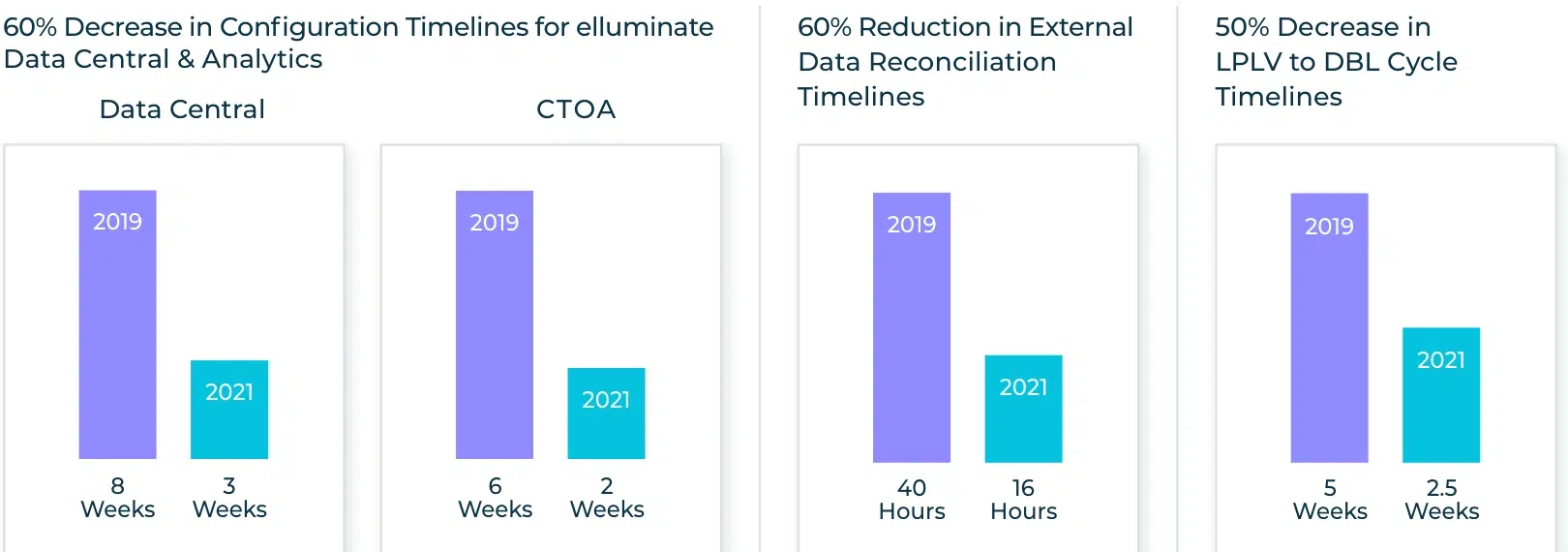
60% Decrease in Configuration Timelines for elluminate Data Central & Analytics
These outcomes represent the configuration timelines for elluminate Data Central and Clinical Trial Operational Analytics (CTOA) applications. The Data Central timeline includes receiving data from Medidata Rave and other external data providers and making defined exception listings and patient profiles available. CTOA includes a variety of metrics from Medidata Rave and other external data providers to demonstrate operational insights.
60% Reduction in External Data Reconciliation Timelines
This metric represents the reduction in time spent per month, per vendor.
Phase 1b study, 182 subjects
50% Decrease in LPLV to DBL Cycle Timelines
This metric represents the reduction in time spent between last patient / last visit and data base lock.
2019-2020 = 7 Phase 1b studies; 6 external data sources 2021 = Phase 1b study, 182 subjects
By improving processes on a continuous basis, providing the team with role-based training, and communicating the value of these initiatives across the organization, the Data Services team was able to establish a scalable framework for providing technology enabled services and increasing customer satisfaction. The team is well positioned to expand services offerings with the deployment of Risk-Based Quality Management (RBQM) and Statistical Computing Environment (SCE).