






The Takeaway From CDMI: Clinical Data Teams Are Getting More Practical About AI
Blog
October 7, 2026

Over the past decade, Risk-Based Quality Management (RBQM) has become firmly embedded in regulatory guidance. What began as a shift away from uniform oversight under ICH E6(R2) has continued to evolve. ICH E6(R3) reinforces expectations for continuous, risk-based, and data-driven trial oversight—an approach that would be difficult to support through manual processes alone. The ability to operationalize RBQM now depends heavily on the technology used to enable it.
Technological advances in analytics, data integration, and centralized oversight have made RBQM as identified in ICH E6(R3) possible. But not all approaches to RBQM technology are designed to support the new regulatory expectations equally. Which types of solutions are best positioned to support the new regulatory guidance?
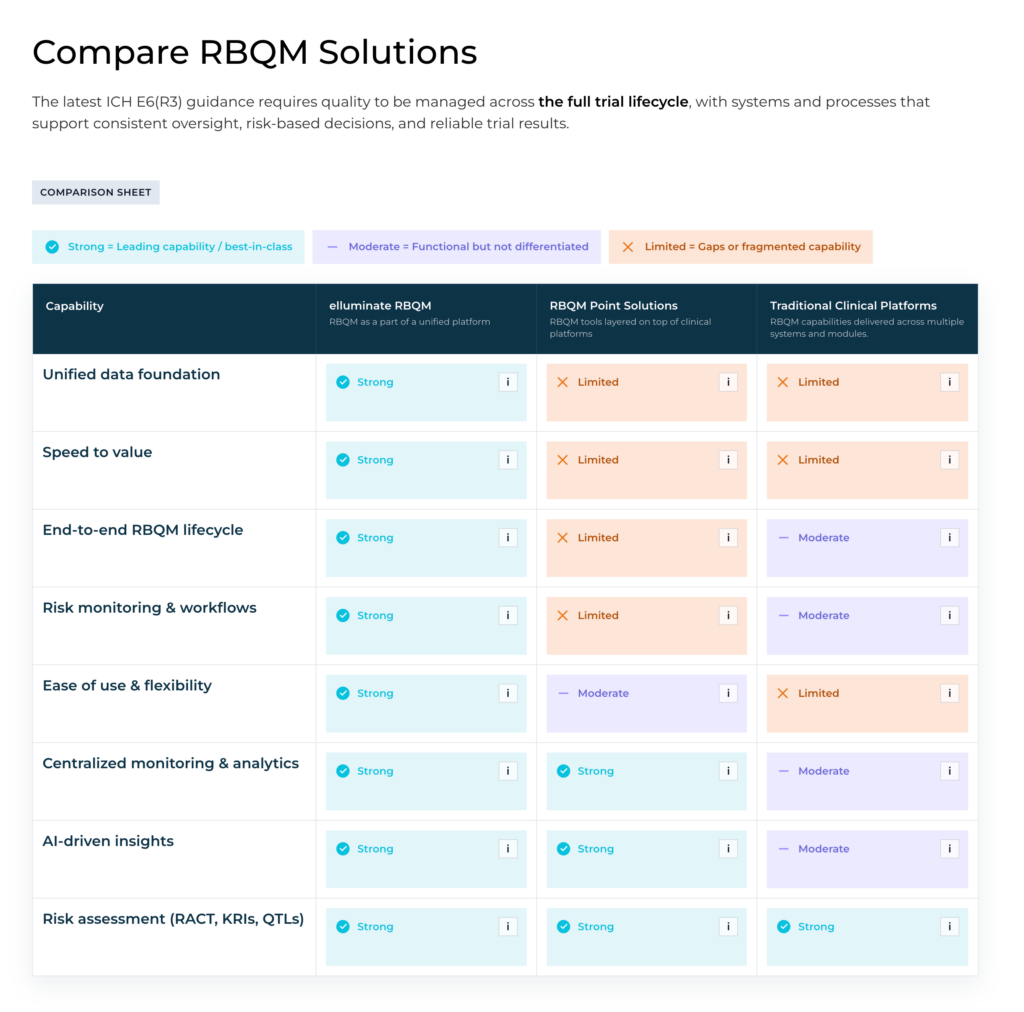
In this blog, we examine three common types of RBQM technology—point solutions, traditional clinical systems, and integrated RBQM platforms—and compare how effectively each supports the full RBQM lifecycle.
Before comparing solutions, it’s helpful to translate regulatory guidance into operational terms.
ICH E6(R3) reinforces several expectations that directly impact how RBQM must be executed. This includes:
To execute RBQM in this manner requires technology that can aggregate and harmonize data across systems, detect signals in near real time, connect risks to actions, track outcomes, and provide traceability for decisions.
Point solutions have been central to the adoption of RBQM, particularly in areas such as centralized monitoring and statistical analysis. They are typically designed to address specific components of the RBQM process, most often focused on identifying and analyzing risk signals.
Strengths
Point solutions are particularly effective for identifying emerging risks and supporting centralized monitoring activities. They provide strong analytical capabilities, including:
Challenges
Point solutions are often implemented alongside existing systems rather than replacing them. As a result:
While point solutions are effective for specific components of RBQM, they may not fully support the end-to-end lifecycle expected in ICH E6(R3).
Traditional clinical platforms are designed to support multiple aspects of trial execution. Many of these platforms have incorporated RBQM functionality and have RBQM capabilities integrated across existing modules.
Strengths
These systems are favored by organizations looking to extend existing systems rather than introduce new ones, and these platforms offer broad operational support, including:
Challenges
Because RBQM capabilities within these platforms are often distributed across modules or layered onto legacy architectures, this can introduce challenges such as:
While these platforms support multiple aspects of RBQM, execution often depends on coordination across systems rather than a single, connected environment.
A newer category of RBQM solutions has emerged to address the limitations of fragmented approaches. These platforms are designed to support RBQM across the full trial lifecycle, bringing together risk assessment, centralized monitoring, and review within a more connected environment.
Strengths
Rather than focusing on individual components, these systems aim to enable continuous, data-driven oversight by integrating data, analytics, and workflows. They enable:
Challenges
By connecting data, analytics, and workflows, integrated RBQM platforms are more closely aligned with the move toward continuous, risk-based oversight. While execution can still vary across solutions, this category is generally better positioned to support the lifecycle-based approach emphasized in ICH E6(R3).
When selecting an RBQM system, key considerations include:
Because ICH E6(R3) reinforces the need for RBQM to function as an ongoing, connected process, integrated RBQM platforms are best positioned to support these expectations, particularly where organizations are looking to operationalize RBQM across the full trial lifecycle.